

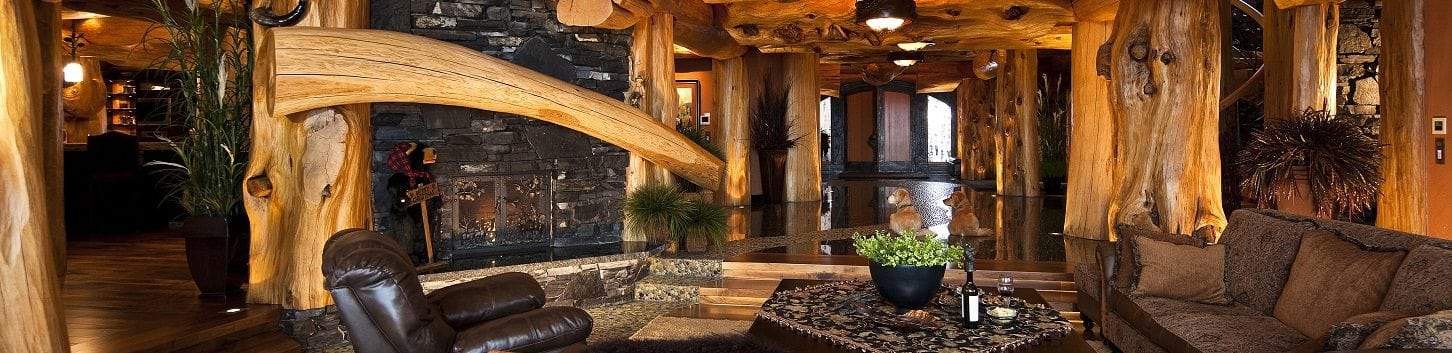
Logs are alive even after they’re felled — they shrink, compress, and settle as they lose moisture. The full-scribe method produces the tightest handcrafted walls, and building for movement is what keeps those walls, and everything attached to them, intact. This lesson walks through both.
The full-scribe process
Full-scribe means every log is individually fitted to the one below along its entire length and at every corner. It is the most demanding log method and the most weathertight.
- Select and peel: Choose logs of suitable diameter and straightness, then debark each one, hand-peeling to the desired surface.
- Lay the course: Roll the next log up onto the wall in its position, rotating it to put the best face out and the natural crown up, and shim it stable.
- Scribe the contour: Run the log scriber along the joint so its twin points trace the lower log’s exact profile onto both faces of the upper log, capturing every dip and bulge.
- Cut the lateral groove and notches: Roll the log over and cut the long concave lateral groove (cope) to the scribe line, then chisel the saddle notches at each corner.
- Fit: Roll the log back, test the seat, and pare away high spots until the groove and notches bed fully with no gaps.
- Stack and seal: Set sealant tape or gasket in the groove, fasten the course down with log screws or through-bolts, and lock the corners.
- Repeat: Carry on course by course until the wall reaches full height.
Engineering for movement
A finished log wall can settle a meaningful amount in its first years — often several percent of its height. Anything rigid that fights that movement will crack, bind, or break, so the whole house is detailed to move.
- Settling jacks: Adjustable screw jacks are placed under posts (porch posts, interior support posts, and post-and-beam members) that do not settle, while the log walls beside them do. Turning the jack down over time keeps the structure level as the logs shrink.
- Slip joints and slotted fasteners: Where stud-framed walls, gable framing, or stairs meet log walls, connections use slotted holes and slip brackets so the frame can slide vertically against the settling log wall instead of being torn apart.
- Oversized openings: Every window and door is framed taller than the unit, leaving a settling space above it (hidden behind trim) so the descending wall never bears on the frame. Vertical splines keep the cut log ends aligned as they slide.
- Detailing services to move: Plumbing and wiring runs through log walls get extra slack and vertical play. Stair stringers attach with slip connections at the top. Tall cabinetry and trim are scribed and fastened so the log wall can move behind them without buckling the millwork.
Get the scribing right and the wall is tight; get the movement details right and it stays that way. The two skills together are what separate a craftsman’s log home from a handsome pile of logs.
Key takeaways
- Full-scribe fits every log to its neighbour along its full length and at every corner — the tightest, most demanding method.
- The process is select/peel, lay, scribe, cut groove and notches, fit, stack and seal, repeat.
- Settling jacks keep non-settling posts level as the surrounding log walls shrink.
- Slip joints, slotted fasteners, and oversized openings let framing and openings move with the wall.
- Plumbing, stairs, and cabinetry must be detailed with slack and slip connections so they move too.