
If you have ever stood inside an old barn or a great hall and admired the heavy wooden skeleton holding the roof aloft, you have already met timber framing. It is one of the oldest building methods in the world, and it is enjoying a strong revival in modern homes. Let’s look at what a timber frame actually is and how it differs from the other ways of building a wooden home.
What a timber frame is
A timber frame is a self-supporting skeleton built from large solid posts (the verticals) and beams (the horizontals). These heavy members carry the entire weight of the house — the roof, the floors, and the loads from wind and snow — down to the foundation. Because the frame does the structural work, the walls between the timbers carry nothing; they exist only to keep the weather out and the warmth in.
The defining feature of true timber framing is the joinery. Members are connected with traditional mortise-and-tenon joints: a tongue (the tenon) cut on the end of one timber slots into a matching pocket (the mortise) cut into another. The joint is then locked with a wooden peg, or pin, driven through a hole bored across it. No structural steel, no nails — just precisely cut wood holding wood.
The joinery up close
This peg-and-pocket approach is what gives a timber frame both its strength and its beauty. A well-cut joint draws the timbers tight as the peg seats, and it can flex slightly under load rather than tearing apart. The joints are left fully exposed inside the home, so the craftsmanship is on permanent display.
Cutting these joints is skilled work. The frame is usually fabricated in a shop, test-fit, taken apart, and then raised on site in a day or two — the famous “frame raising” that timber framers still celebrate.
How it differs from log construction
In a log home, the logs are both the structure and the wall in one — stacked horizontally, they hold up the building and enclose it at the same time. A timber frame separates those two jobs. The frame holds the building up; a separate wall system encloses it. That is the single biggest difference, and it shapes everything else about how the two homes feel and perform.
How it differs from conventional stick framing
A conventional, or “stick-framed,” house is built from many small, light pieces of dimensional lumber — two-by-fours and two-by-sixes — spaced close together and fastened with nails or screws. The structure is hidden inside the walls and covered with drywall. A timber frame does the opposite: a few large members, widely spaced, joined by hand, and left visible. Where stick framing relies on many small parts sharing the load, timber framing relies on a handful of strong ones.
Beauty and open interiors
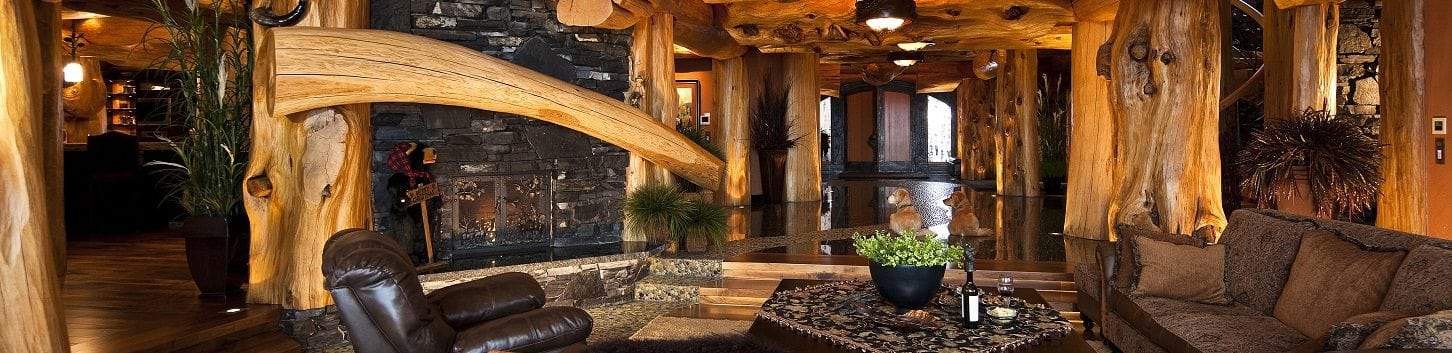
Because the posts and beams carry the loads, you do not need a forest of interior walls to hold the house up. That frees the floor plan dramatically — soaring great rooms, open lofts, and uninterrupted sightlines are all natural to the style. The exposed frame becomes the architecture itself, warm and sculptural, rather than something to be hidden.
A frame plus a separate enclosure
Since the timbers handle the structure, the walls and roof are free to be a dedicated, high-performance enclosure wrapped around the frame. Most commonly this is a continuous insulated shell that envelops the timbers from the outside, leaving them fully visible within. We cover that enclosure in detail in a later lesson — for now, the key idea is simply that a timber-frame home is two systems working together: a strong wooden skeleton inside, and an efficient weather shell around it.
Key takeaways
- A timber frame is a self-supporting skeleton of large posts and beams that carries the whole house.
- Members are joined by traditional mortise-and-tenon joints locked with wooden pegs — no structural steel or nails.
- Unlike a log wall, the frame is structure only; a separate insulated enclosure keeps out the weather.
- Unlike stick framing, it uses a few large, hand-joined members that stay beautifully exposed.
- Carrying the loads on the frame opens up the floor plan for great rooms, lofts, and clear sightlines.