
Before you fall for a particular log home, it helps to know how the logs were made — because almost everything else about the build follows from that one choice. Broadly, log homes come from two traditions: handcrafted and milled. They share a heritage but diverge sharply in how a wall comes together.
How handcrafted logs are produced
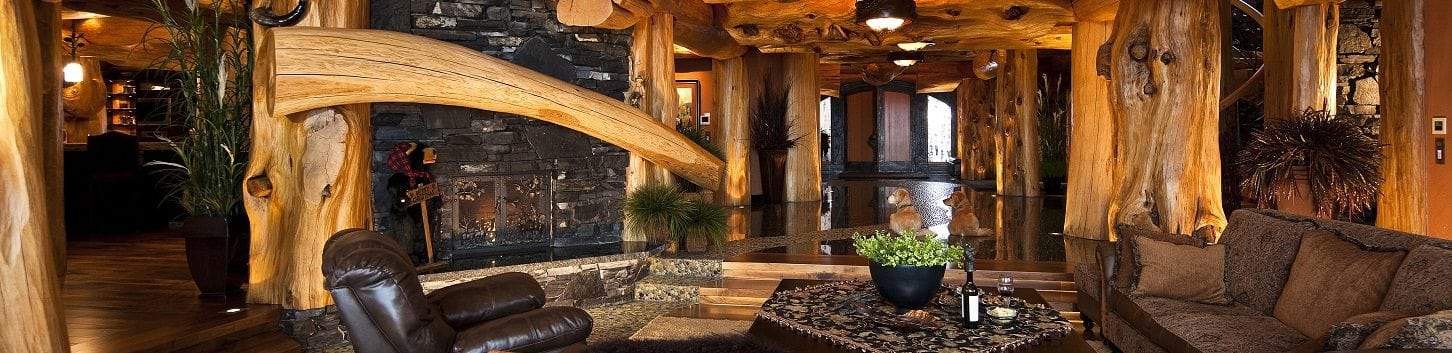
In the handcrafted method, whole trees are used much as they grew. Each log is debarked — often hand-peeled with a drawknife to leave the natural, slightly undulating surface — but it keeps its full length, its natural taper, and its individual character. No two logs are alike, so each one is fitted to its neighbour by hand.
The defining step is scribing. A builder lays one log atop the one below, then traces the exact contour of the lower log onto the upper using a scribing tool fitted with a level and matched pencils. The upper log is then rolled off, and a long lateral groove is carved to match that traced line so the two logs nest together along their full length. Corners are cut as interlocking saddle notches. This is the tradition Pioneer Log Homes of B.C. has practised since Bryan Reid founded the company in 1973 — the craft showcased on HGTV’s Timber Kings, where massive Western red cedar and Douglas fir logs are scribed and chiselled by hand.
How milled logs are produced
Milled (or machine-profiled) logs run through industrial machinery that cuts every log to a uniform cross-section — round, D-shaped, or rectangular — with a consistent diameter down the whole length. The taper is gone; a milled log is the same size at both ends. Tongue-and-groove or double-tongue profiles are routed along the top and bottom so logs stack like oversized building blocks. Lengths and corner notches are typically pre-cut at the factory, producing a numbered kit.
The tradeoffs
The differences are real and worth weighing honestly.
- Character: Handcrafted walls have organic variation, large diameters, and a sculptural look. Milled walls are clean, uniform, and predictable — a different aesthetic, not a lesser one.
- Cost: Handcrafted homes carry more skilled labour and usually cost more. Milled kits leverage machine efficiency and are generally more economical per square foot.
- Consistency: Milled logs interchange and assemble fast with a smaller crew. Handcrafted shells are fitted as a unique set and demand experienced hands.
- Assembly: A milled kit arrives ready to stack on site. A handcrafted shell is typically built and fitted at the builder’s yard, disassembled, then trucked and re-erected on your foundation.
Who each suits
Choose handcrafted if you want a one-of-a-kind home with dramatic, full-diameter logs and you value craft over cost. Choose milled if you want tighter budget control, faster assembly, and a uniform look — or if you intend to do part of the assembly yourself. Both, built well, last for generations; the right answer is the one that matches your priorities and your wallet.
Key takeaways
- Handcrafted logs keep their full length and natural taper, and are individually hand-scribed and notched to fit.
- Milled logs are machine-cut to a uniform profile and assembled as a kit-like system.
- Handcrafted offers more character but more cost and labour; milled offers consistency, speed, and economy.
- Pioneer Log Homes of B.C., founded by Bryan Reid in 1973, is a long-running example of the handcrafted tradition.
- Pick the method that fits your priorities — both make durable homes.