
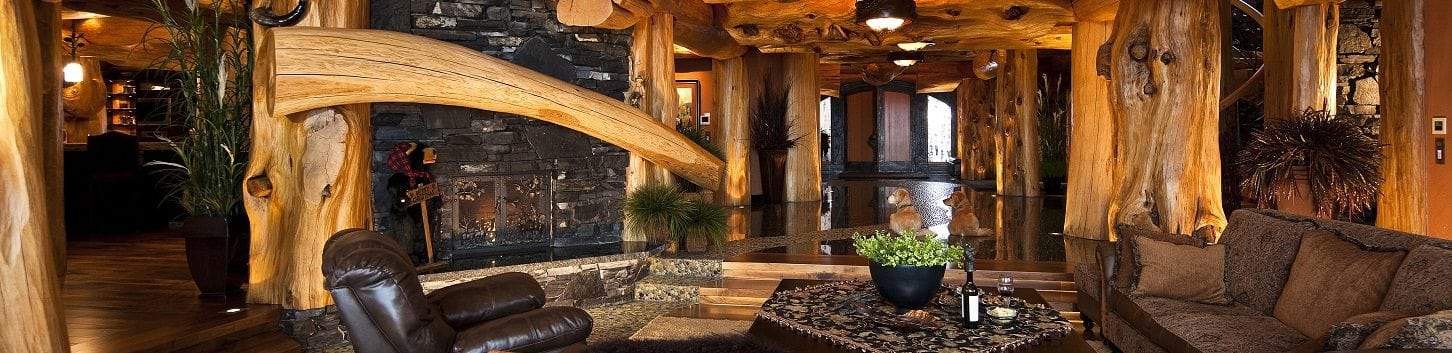
The logs themselves are the single biggest character decision you’ll make. Species, profile, corner style, and wall system all affect how your home looks, how it performs, and what it costs. Here’s how to think through each so you can choose with confidence rather than guesswork.
Species and their tradeoffs
No species is “best” — each balances appearance, stability, rot resistance, and availability differently.
- Western Red Cedar. Lightweight, naturally rot- and insect-resistant, dimensionally stable, with a warm tone. A premium choice, often the priciest, and a hallmark of B.C. builders.
- Douglas Fir. Strong, dense, and straight-grained with tight knots — excellent for large structural logs and trusses. Heavier and can check (surface crack) as it dries.
- White / Eastern Pine. Soft, easy to work, stable when properly dried, and widely available at a friendly price. Takes stain beautifully; less naturally rot-resistant, so detailing and finish matter.
- Spruce / Lodgepole Pine. Common and economical with a clean, uniform look. Often used in handcrafted homes; needs good drying and maintenance to stay sound.
Log profiles
The profile is the cross-sectional shape of the log, and it sets the home’s whole personality.
- Round. The classic full-round look, rustic and bold. Round inside and out.
- D-profile. Round on the outside, flat on the inside — keeps the cabin exterior while giving you straight interior walls that are easier to furnish.
- Square / rectangular. Flat faces all around for a clean, sometimes more contemporary or historic look; easier to seal and finish.
- Swedish cope. A round log with a concave groove milled into its underside so each log nests tightly over the one below, giving a snug, weather-tight stack.
Corner styles
Corners are where craft shows most. They affect strength, weather sealing, and curb appeal.
- Saddle notch. The iconic rounded notch with log ends overhanging the corner — handcrafted and rustic.
- Dovetail. Interlocking angled joints, often on square logs, with flush corners and a tidy, historic feel that sheds water well.
- Butt-and-pass. One log butts into the side of another that passes by; simple, strong, and economical.
- Corner post. Logs terminate into a vertical post, giving clean lines and accommodating settling and varied wall lengths.
Full-scribe versus chinked walls
Finally, decide how the logs meet each other vertically. In a full-scribe (or chinkless) wall, each log is hand-fitted to the contours of the one below so they seal without a visible gap — the look is tight, sculptural, and all wood. In a chinked wall, logs are spaced and the joints filled with a flexible chinking material (traditionally mortar-like, now usually synthetic), giving the striped white-line-between-logs look of a classic cabin and allowing more uniform logs.
A useful way to choose: start with the feeling you want (rustic round versus clean lines), confirm the species available in your region and budget, then let your builder match a corner style and wall system that delivers that look while handling your climate.
Key takeaways
- Choose species by balancing look, stability, rot resistance, and budget — cedar and fir sit at the premium end, pine and spruce are friendlier on cost.
- Profile sets personality: round and Swedish cope read rustic, D-profile and square give flatter interior walls.
- Corner style (saddle notch, dovetail, butt-and-pass, corner post) affects strength, weather sealing, and curb appeal.
- Full-scribe gives a tight all-wood look; chinked gives the classic striped cabin look with more uniform logs.
- Decide on the feeling first, then let species, corners, and wall system serve it.