
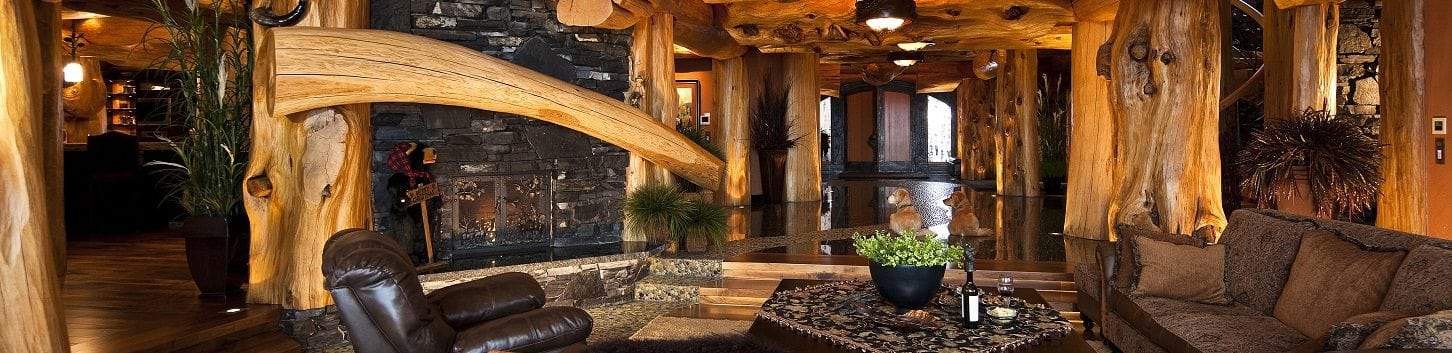
Before you fall for the photos, it’s worth asking an honest question: is a log home actually the right fit for how you want to live? This lesson helps you answer that without the marketing gloss.
Who tends to thrive in a log home
Log homes reward people who genuinely want a connection to the outdoors and don’t mind a home with character over uniformity. The happiest owners tend to share a few traits:
- They value natural materials and the warmth of real wood over a perfectly square, builder-grade finish.
- They enjoy being a hands-on steward of their home, or are willing to hire out a little routine care.
- They’re drawn to a setting with land, light, and views, and plan to spend real time enjoying it.
If you want a zero-maintenance condo feel, a log home will frustrate you. If you like the idea of a home that ages with you and tells a story, you’re in the right place.
Buy existing or build new?
There are two real paths, and they suit different people.
Buying an existing log home is faster and lets you see exactly what you’re getting. You can inspect the wood, the finish, and how it has weathered. The trade-off is compromise: someone else chose the floor plan, the site, and the species of wood.
Building new gives you control over layout, location, and quality, and lets you choose between a handcrafted home (logs scribed and fitted by hand) or a milled package (uniform machined logs). The trade-off is time, decisions, and managing a project. Companies like Pioneer Log Homes of B.C., founded by Bryan Reid in 1973 and later featured on HGTV’s Timber Kings, are an example of the handcrafted end of that spectrum.
Realistic timeline and budget
From the moment you commit to building, plan on roughly 6 to 18 months before move-in. Design and permitting eat the early months; log package production, the shell raising, and finish work fill the rest. Weather, lender draws, and your own decision speed all move that number.
Budget honestly and early. A log home is not just the logs, it’s land, site work, the build, and finishes. We cover the full picture in the next lesson.
Correcting two stubborn myths
Two myths scare off good buyers, and both are mostly wrong.
“Log homes are drafty.” Modern log walls are sealed with engineered chinking and gaskets, and the logs themselves provide thermal mass, soaking up daytime heat and releasing it at night. A well-built log home is often more comfortable, not less.
“Log homes are high-maintenance” is the second. The reality is predictable maintenance: a wash and a fresh coat of stain every few years on a stain cycle you can plan and budget for. It’s a known chore, not a constant surprise.
Honest pros and cons
Pros: natural beauty, comfort from thermal mass, durability when cared for, and strong resale appeal in the right market. Cons: the upkeep cycle, a higher cost per square foot than conventional builds, and fewer builders and lenders who specialize in them.
Questions to ask yourself
- Do I want this for the lifestyle, or just the look?
- Am I comfortable with a stain-and-seal cycle every few years?
- Can my timeline absorb 6 to 18 months if I build?
- Does my budget hold up once land and site work are added in?
Key takeaways
- Log homes suit people who want a connection to nature and accept light, predictable upkeep.
- Buying existing is faster; building new gives control but takes 6 to 18 months.
- “Drafty” and “high-maintenance” are largely myths: thermal mass and a planned stain cycle tell the real story.
- Decide based on lifestyle fit, not just the photos, and pressure-test your timeline and budget.